

By Edward Niedermeyer on November 5, 2009

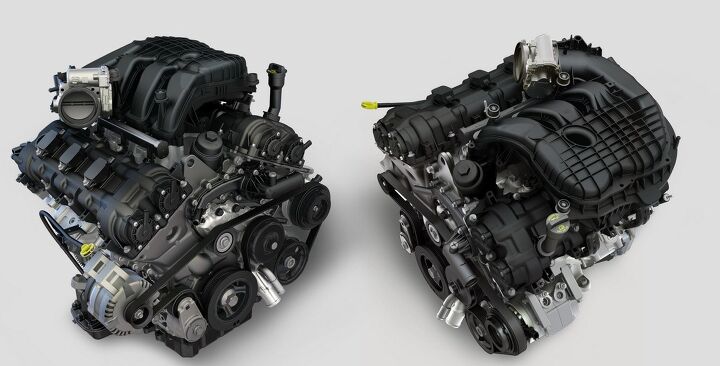
Pentastar V6... the technology Chrysler didn't need help with

One of Chrysler’s major problems in the powertrain department is a mass of V6 engines of varying ages and displacements. The lack of interchangeability between engines contributes to Chrysler’s unprofitability, and the advanced age of some hurts overall fuel efficiency considerably. The debut of a brand-new Pentastar V6, arriving with next year’s Grand Cherokee, will change all that. The 280 hp, 260 lb-ft engine will replace all of Chrysler’s V6s, and handily gives Fiat their only modern V6. Single and twin-turbo versions are being considered. Meanwhile V8s aren’t going away, with 5.7 and 6.4 liter versions planned.

The World Engines of 1.8, 2.0 and 2.4 liter displacement will continue, also providing Fiat with a lower-cost alternative to its more advanced but more expensive engines. Fiat does plan on introducing its Multiair technology as well as direct injection to the workhorse World Engine family, although no time frame has been given for such a  development.

Fiat will provide its Multiair 1.4 liter “Fire” engine, although the only known application is the 500. A turbocharged 1.4 will arrive in 2011 with the 500 Abarth, and potentially thereafter in Fiat-based Dodge and Chrysler B-segment (Yaris/Fit) hatchbacks, planned for 2012. The Fire family is unlikely to be used outside of the B-segment for the simple reason that in non-turbocharged form, the engine produces only 100 hp and 92 lb-ft. Fiat’s JTD diesel engines in 1.6 to 2.0 displacement are mentioned in the presentation, but they seem unlikely candidates for powering Wrangler, the only vehicle confirmed with a diesel option. Dual clutch transmissions will debut with the refreshed Sebring in Q4 2010.

By far the biggest question surrounding Chrysler’s powertrain plans is in regards to electrification and hybrids. Fiat brings little to no expertise to the table in this area, and Chrysler’s ENVI vaporware wasn’t mentioned once in the whole 7 hour presentation. Marchionne dismissed the idea of consumer-market hybrids or EV’s in the short term, calling electrical storage technology “unready.” Only a Fiat Doblo-based commercial EV is on the radar. If Chrysler ever gets past its short-term issues, it hopes to have improved its fleet efficiency by 2014 through proliferation of Fiat’s technology and the use of more four-cylinder engines. If they begin thinking about an IPO though, look for talk of futuretech to come back around again, as investors will want more long-term upside than is currently on offer.

26 Comments on “Chrysler: The Powertrain Plans...”


  • Garrick Jannene
    CommanderFish

    From what I know, the Pentastar V6’s were originally supposed to come in 4 displacements, 3.0L, 3.3L, 3.6L, and 4.0L. The 4.0L is all but dropped, I believe. The 3.3L is coming out later, with use mainly in minivans and D-segment vehicles. The 3.0L was originally designed with export markets only in mind, so I’m going to guess this is the engine that Fiat is most excited about.

    I don’t know timetables on anything, sorry.

  • Douglas Ford
    dwford

    New motors from Chrysler designed during the Cerberus years. Brrrr I just got the shivers.

  • Stingray

    dwford

    I’m sure those engines started way before the Cerberus period. An engine takes about 5 years to get designed.

    The diesel powering the wrangler must be the JTD or HPi 3.0 lts 4 cyl employed in the Iveco Daily. I think it has 180HP

  • ellomdian

    I’ve changed my mind. I think we will get the Abarth 500. It will just cost $35k for the privilege, 5 years after Europe got it.

  • John Horner
    John Horner

    The Pentastar V6 used to be called the Phoenix V6 and at least initially was a Chrysler & Mercedes co-development project slated to be the base design for both to use in the future.

    Chrysler’s current 4 cylinder World Engine was a co-development project between Chrysler, Hyundai and Mitsubishi.

  • colin42

    What about the Diesels? It’s clear that the Cummins 6.7 will stay in the HD Ram trucks

    The presentation talks about bringing the 1.6 & 2.0 ltr Diesel engines over which would be fine for small to mid size cars and small SUV’s but what about the larger SUV’s & light duty trucks?

    The suggestion is that Iveco unit would be used, but they don’t have anything in the light duty market with enough power.

    Several years ago I remember a story that Maserati (a.k.a. Fiat) were considering offering a diesel car and they were looking at VW’s 5.0 V10 (before the days of the 6.0 V12)

  • 26theone

    The Multiair is for A segment cars though not B. A segment car sales will be very small in the US for long time.

  • Douglas Ford
    dwford

    Chrysler’s current 4 cylinder World Engine was a co-development project between Chrysler, Hyundai and Mitsubishi.

    And yet, start up a Hyundai Sonata with the 2.4L, then do the same with a Dodge Avenger or Mitsu Galant with the same motor. Shockingly different level of refinement.

    I’m sure those engines started way before the Cerberus period. An engine takes about 5 years to get designed.

    That doesn’t make me feel better. MB started Chrysler’s ruination in the first place!

  • Garrick Jannene
    CommanderFish

    dwford,

    Mercedes also wanted to use the Phoenix/Pentastar V6’s. That means they wouldn’t have purposely made them crappy like many of Chrysler’s products.

    I still want an ME412, personally.

  • CarPerson

    60-degree or a boat anchor 90-degree?

  • CarPerson

    Ok, here is some poop on the engine:
    http://www.allpar.com/mopar/phoenix-engines.html

    It’s a 60-degree.

  • john.fritz

    I wonder how much of a mess that oil filter will make when you swap it out. It looks awfully small too, like those tiny filters on Northstars.

    Not trying to knock it though, certainly appears to be an innovative design in several respects. Nice torque/HP numbers too.

  • bumpy ii

    That’s one of those canister+snorkel type of filters; pretty typical for European-designed engines these days. The actual filter element probably goes halfway down to the oilpan. MB’s former influence at work there.

    It’s nice to see that Chrysler finally has a good workhorse six, but wake me up when I can find a USDM diesel 500 at the Dodge dealer.

  • Via Nocturna

    Ah, well there’s some welcome news from ChryCo at last. With Ford’s Duratec 3.5 and GM’s 3.6 “high-feature” now established powerplants, a replacement for the crude 2.7s and 3.3s is long overdue. Who knows, maybe a V6 Charger/300 might actually be a bearable prospect with this new series of engines.

  • Gerald Starr
    50merc

    dwford: “start up a Hyundai Sonata with the 2.4L, then do the same with a Dodge Avenger or Mitsu Galant with the same motor. Shockingly different level of refinement.”

    So I’ve heard. So have Dodge and Mitsu made some modifications to the original design? Or has Hyundai? Or does Hyundai take more care (e.g. using more precise tolerances, matching pistons by weight) in making the engine?

    Anyone know? I’m certainly ready to believe Chrysler is just throwing parts together and hoping most of the nuts and bolts are put in.

  • seanx37

    So, are any of these new engines going to be as strong,smooth, and efficient as HONDA/TOYOTA/NISSAN? No? Are the cars going to be as good as those? If not, then why bother?

  • Dean Bergman
    Juniper

    dwford/50merc
    I drive a 2.4L Chrysler every day. Very smooth, quiet, no vibration transferred to wheel dash or pedals.
    You never did this test you talk about did you?
    I didn’t think so.

  • PeteMoran

    Multi-air is somewhere ahead of “simple” variable valve and obviously plain dual-cam, but 10% appears to be an optimistic claim. The 10% saving comparison is to single cam, fixed timing engines.

    Other similar systems are; Porsche VarioCam (stepped), BMW Double VANOS/Valvetronic(infinitely variable), Toyota Valvematic (2007) etc….

    Nice implementation however, and I just had a quick look; extensively patented.

  • Douglas Ford
    dwford

    So I’ve heard. So have Dodge and Mitsu made some modifications to the original design? Or has Hyundai? Or does Hyundai take more care (e.g. using more precise tolerances, matching pistons by weight) in making the engine?

    I think it has to do with the starter and engine mounts and sound insulation. The starter makes a rude sound when you twist the key, the engine rumbles to a start with a shiver and it is very loud compared to the Hyundai.

    You never did this test you talk about did you?

    I have driven Sebrings, Avengers, and Galants – all current bodystyle with the 2.4L. They are all the same, horrible.

  • moedaman

    dwford :
    November 5th, 2009 at 7:10 pm
    I’m sure those engines started way before the Cerberus period. An engine takes about 5 years to get designed.

    That doesn’t make me feel better. MB started Chrysler’s ruination in the first place!

    Also how many people were working on that project during the Cerebus years? Enough to make sure things were right?

    I’m amazed that Chrysler/Fiat admitted that they currently have quality problems, yet there are people who claim those vehicles are smooth running and very good. My experience with those folk is that they have little to no expeience with modern Japanese/Korean vehicles. Or their only experience with foreign cars were with poorly built 70’s model european cars.

  • Autojunkie

    50merc :
    November 5th, 2009 at 10:32 pm

    dwford: “start up a Hyundai Sonata with the 2.4L, then do the same with a Dodge Avenger or Mitsu Galant with the same motor. Shockingly different level of refinement.”

    So I’ve heard. So have Dodge and Mitsu made some modifications to the original design? Or has Hyundai? Or does Hyundai take more care (e.g. using more precise tolerances, matching pistons by weight) in making the engine?

    Anyone know? I’m certainly ready to believe Chrysler is just throwing parts together and hoping most of the nuts and bolts are put in.

    I worked with engineering prior to the WE launch. It’s amazing how different the Chrysler version is from the Hyundai version. Chrysler had to make a ton of changes to refine this engine they were being forced to use. It’s pretty much become its own engine “based” off of a Hyundai design.

    @Juniper – As for the 2.4 in the minivan. I don’t argue with any of your points, but it needs to be known that the 2.4 in the minivan, and the 2.4 WE, are completely different engines. Regardless… I see no issues with either of them. I’ve driven many of the old and new generation of Chrysler 4-cylinders and find nothing wrong with any of them.

  • carve

    Regarding multiair/valvetronic type set ups: Why does it matter whether you throttle the engine via a throttle plate or a barely open valve? The pressure drop and pumping losses must necessarily be the same…otherwise you’re just not throttled down as much and you close the valve until you are. I don’t see where the efficiency gain could be.

    The only advantage I can think of is quicker throttle response, by the amount of time it takes for the pressure wave to travel from the throttle plate to the valve. That’s not much of an advantage, especially for the added complication.

  • Michael HAmmer
    Sinistriel

    @dwford
    The USDM Galant does not use the World Engine. It uses the older Mitsubishi designed 2.4.

  • John Horner
    John Horner

    “It’s amazing how different the Chrysler version is from the Hyundai version. Chrysler had to make a ton of changes to refine this engine they were being forced to use.”

    Interesting. I haven’t driven any of the Chrysler WE engine equipped vehicles, but I have driven the four cylinder 2008 Sonata and am very impressed with its refinement. My daily driver is an Acura TSX with Honda’s high developed four cylinder engine, so I do have a good baseline to compare the Hyundai to.

    Could some of those tons of changes have been due to a bit of NIH (not invented here) clouding Chrysler’s judgment? After all, Hyundai is kicking butt whilst Chrysler is on life support.

    Comparing quality and reliability ratings reports between a Hyundai Sonata and a Chrysler Sebring leads one to conclude that Hyundai has been doing a much better job of engineering and building cars than Chrysler has been doing.

  • AdamYYZ

    I’ve been working on this engine’s water pump/front engine cover assembly. Production is about to begin on it shortly. For what its worth, Chrysler have been watching over us closely and have very high expectations for quality control. Tolerances are held very tight. Probably good signs for the future.

    I can’t help but wish them well since the Chrysler job kept me employed during the recessions darkest days.

  • SV

    The Phoenix looks very promising, too bad there aren’t any decent cars to put it in yet (bar the new Grand Cherokee and, possibly, the new Charger/300)

    My feeling with the differences between Hyundai and Chrysler 2.4 engines is that they’re more to do with how the engines are installed in the car (better mounts, more insulation in the Sonata maybe?) than the engines themselves but I probably don’t really know what I’m talking about.


Back to TopLeave a Reply

You must be logged in to post a comment.

You can also login using Facebook Connect. Connect with Facebook

Subscribe without commenting

Recent Comments


Auto Insurance GPS Navigation
Car Loans Auto Parts
Car Warranty Wheels
Automotive Tires Car Care