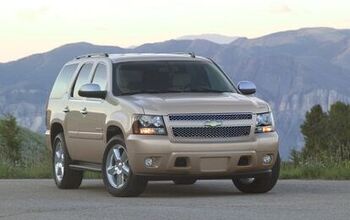


Let's get something out of the way right now: the Yukon Hybrid is over-priced. Our tester stickered at $56k. At that price point, GM's gas – electric SUV competes against BMW's enlarged X5, Audi's Q7 carcoon and Lexus' golf club friendly RX 400h (to name a few). Hybrid or no, the GMC Yukon's not exactly what you'd call an upmarket machine. If The General had taken the hit and offered the Yukon Hybrid for the same price or less than its gasoline equivalent, it would be a far more compelling proposition. But they didn't. So let's press on.
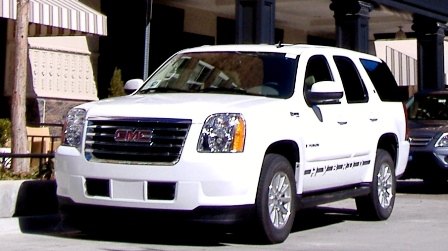
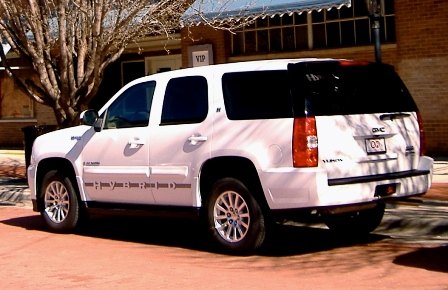
Aesthetically, the Yukon Hybrid is about as bashful as a drunken sorority girl at Panama City Beach Spring Break. The big rig's plastered with no fewer than nine proclamations that it possess a gas-electric drivetrain, including three-foot-long "Hybrid" stickers along its mighty flanks. Custom side skirts, a rear spoiler and good-looking low-weight 18-inch wheels add more not-so-subtle style (and mpgs) to the equation.
Other than that, it's a Yukon: big, bland and boxy. OK, the SUV's creases were sharpened pre-Hurricane Katrina, but the Yukon's looks still aren't going to blow anyone away.
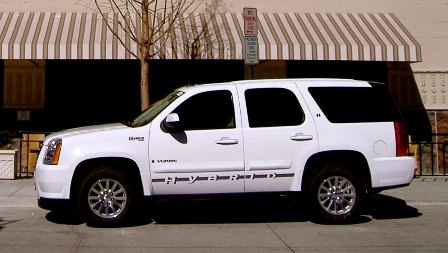
To drop the Yukon Hybrid's aerodynamic Cd from .39 to .34, GM re-softened those sharpened creases with a slightly reshaped hood and rear hatch, and lost the roof rack. Although the new hood and hatch are fashioned from aluminum, the Yukon Hybrid's batteries and electric motor make it heavier than the standard model. The Yukon Hybrid's heft rises from either 5270 to 5541 lbs., or from 5438 to 5617 lbs., depending on whether you believe GM PR or the GMC website.
GM's new truck interiors may be far better than anything they've ever offered, boasting attractive chrome accents and a real woven headliner. But at $51k (base), the Yukon Hybrid's interior feels cheaper than a Las Vegas motel on a Tuesday afternoon. Fake wood and aluminum abound. Vinyl that tries (and fails) to look like leather stretches across the ample dashboard. The seats are flat and unsupportive, and the optional third row seat is unusable for anyone but Hobbits.
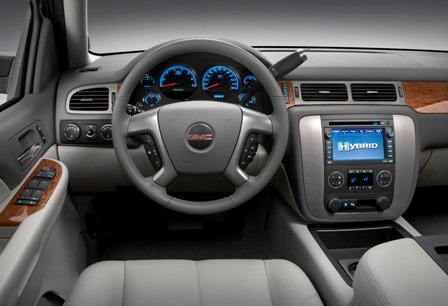
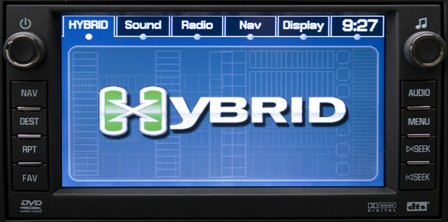
The Hybrid comes amply-equipped with navigation, rear parking camera, auto climate control and power everything. In complete contrast to the exterior, only a small Hybrid logo, an "Eco" gauge and a Prius-like touch screen drivetrain display remind the driver that they're piloting the world's largest private passenger hybrid.
To maintain the Yukon's cavernous interior, the engineers utilized the undercarriage space for the NiMH batteries. Part of that space was realized (and the beast's weight gain minimized) by replacing the full-size spare tire with a can of sealant– not exactly what you'd expect in a 4×4. Not that you'd ever take those low-rolling-resistance donuts off-road. On the positive side, the Yukon Hybrid 4X4's towing capacity is a respectable 6000 lbs. (down from 8000 lbs.).
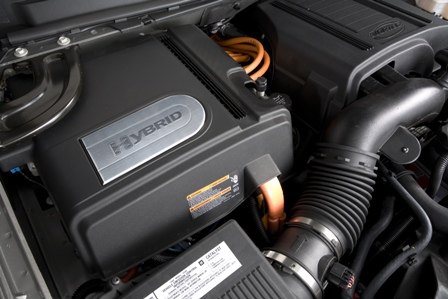
Which may account for GM's decision to equip the Yukon Hybrid with a 332hp, 6.0-liter Vortec engine. In any case, the monster motor becomes a hybrid with the addition of a 300V battery, two 60KW motors in the transmission and some creative software.
I've never driven a full hybrid this seamless in operation. You never notice when the drivetrain changes modes, from electric to gas and back. The electric boost comes on smoothly; the power delivery remains silken as the engine spools-up. When revved hard, the 6.0-liter offered a muted yet spine-tingling burble. Despite the weight, the excellent drivetrain pushes the Yukon from zero to sixty miles per hour in about eight seconds. The system manages a decent-for-such-a-behemoth 20mpg both in the city AND on the highway.
The Yukon Hybrid's suspension is as ridiculous as the drivetrain is sublime. The steering feels vague at low speeds and darty on the highway. Engaging four-wheel-drive mode makes the rig feel like a forklift, with all four wheels pushing in different directions. The Yukon skitters and wallows during cornering and shudders like a Sebring convertible over rough patches. The massive weight smooths out the ride to decent levels, but the European and Japanese competition put the Yukon to shame in comfort, control and cornering ability.
As for that highly-touted 25 percent fuel economy improvement, yes, I achieved the advertised mpg in mixed driving. But I wonder how much of that gain's down to the non-drivetrain mods. Equally perplexing: why hasn't GM incorporated them into normal Yukotahburbelades? Is the American automaker shortchanging their gas-powered SUVs to protect the hybrid versions' rep? Clearly, the Yukon Hybrid raises more questions than it answers. Meanwhile, one thing is for sure: at that price, in this market, the Yukon Hybrid will not be flying off the lots.
82 Comments on “2008 GMC Yukon Hybrid 4×4 Review...”
Back to TopLeave a Reply
You must be logged in to post a comment.
You can also login using Facebook Connect.


“Hybrid” is a kind description of this beast; but I think the proper term: “Mongrel” was eschewed by GM brass.
a drunken sorority girl at Panama City Beach Spring Break
Mike, I am more interested in hearing more about this than I am about this oversized, overpriced clunker.
SIGH. Yet another example of excellent D3 engineers being forced to build mediocre products by (less than) mediocre management.
I have a 07 Denali for my 4 little urchins that will not do better than 14 MPG around town. I think a 25% improvement is off the hook!
At 56K, I would buy a slightly used Infiniti M45 Sport and a used Toyota Prius.
frontline:
I have a 07 Denali for my 4 little urchins that will not do better than 14 MPG around town. I think a 25% improvement is off the hook!
So, what if you could get, say 10 percent better mileage without paying any premium? You know, if they smoothed over your truck’s body, put it on skinny tires, lost the spare tire, added skirts and stuff and used the smaller engine?
I wonder how many of these are destined for government agencies. Many state and federal fleets are now required to have a certain percentage of hybrids or alternative fuel vehicles in their mix. If you run a state highway, and have to have a hybrid, I guess this is something to think about.
Really, why didn’t they use the smaller engine? That seems like a no-brainer to me.
Or perhaps do something shockingly un-GM and use a V6 or diesel engine?
As it sits, this thing seems utterly pointless.
Changing aerodynamic Cd from .39 to .34 and getting rid of the roof rack seemingly could be called a green “pony” package for $1000. Skinnier tires and lowering the vehicle, in addition to the above, should result in the greatest gains in highway mpgs. The 6.0 v8 gets 27,28 highway on a Corvette, yes that’s less weight, but it’s also a lot less drag.
At 56K it really doesn’t make economic sense to buy this for the fuel economy, it’s more about saving the planet or whatever. Two questions that come to mind are what is it going to take to fix this thing (not if but) when it breaks and why isn’t this technology being deployed in a pickup truck, something that working people use more. I mean if a small businessman can trim 25% off his fuel costs and drive it 100K in 2 years he might come out ahead financially while saving the planet(or whatever).
Why are American men and women so afraid of station wagons? I had a Focus wagon that was bigger inside than a Cherokee, and got over 30 mpg highway.
I analyzed the price of this one here:
http://www.truedelta.com/blog/?p=200
The premium vs. the regular Yukon is over $9,000.
Concerning the question at the end of the review, nearly all of the fuel economy benefit is from the powertrain. The weight savings likely improve fuel economy by only a few percent. They cost too much to be worth this small benefit, at least on the regular Yukon. On the Hybrid they might keep the truck from entering the next test weight class, and thus might help the EPA numbers quite a bit even if they have just a small impact in the real world.
I love the way the phrase “shudders like a Sebring convertible” links to a Chrysler ad.
The powertrain seems impressive in and of itself. They could just put it in the Escalade to justify the price and differentiate the Cadillac from the rest of the GM SUV’s. I guess that wouldn’t sell enough, but I think the long term effects would be better. By the way, lose the hideously garish “hybrid” badges along the flanks have to go. They are insulting to the very customers who are purchasing these things.
Apparently they are developing this dual-mode for smaller applications, as it is supposed to be put in the Vue next year. But that Vue will probably cost $40k. However, it will likely be applied to other vehicles with the same V-6, such as the Lambda’s, the Malibu, etc…and at some point they should find a good cost & platform combination.
This hybrid system will be rolled out in the Silverado’s as well. I also worry about the powertrain reliability on these…sounds expensive to fix.
Michael Karesh :
Concerning the question at the end of the review, nearly all of the fuel economy benefit is from the powertrain. The weight savings likely improve fuel economy by only a few percent.
Dropping the Cd from .39 to .34 would have a huge impact on freeway mileage. Those skinny low rolling resistance tires would also be a boon. Extra weight wouldn’t affect highway mileage, but does affect the city mileage. I wouldn’t be so quick to ignore those non-drive train changes.
I’m also a bit curious as to why they didn’t put this hybrid technology into the Escalade instead.
The Yukon will have a $2200 tax credit which will bring the premium down to $6800. Different states also have some very unique subsidies, incentives, and taxpayer’s money handouts to help sell this SUV to an oil executive.
Here’s a few hundred ‘alternative’ hand-out’s…
http://www.eere.energy.gov/afdc/progs/in_matrx.php
As far as the Fed’s go the Altima will have a $2350 credit. If someone can explain to me why that model has a larger federal tax credit than the Yukon please let me know.
GS650G: “At 56K it really doesn’t make economic sense to buy this for the fuel economy, it’s more about saving the planet or whatever.”
Then it’s about whatever, because it sure isn’t about saving the planet. Saving the planet is riding the bus, biking, walking or, if one must drive, buying a Prius or other small, thrifty car.
Making an aero package available could be done at a small price. It probably should be optional, as it changes ground clearance and some might actually find that unwelcome (you know, the few people who actually drive these things on something other than freeways).
And an aero package would make a big difference to the ones that are doing 20 over on the freeway.
The aero package could be added as a “green option”, but if they made it standard across the entire Yukotahbureblade range, then the cost would be extremely minimized.
The biggest problem with the aero package would be aluminum paneled SUV’s that would eventually need body work. Aluminum is very hard to work with, ask any Audi A8 owner, their vehicles are shipped off to “Audi Refurbishment Centers” when they get pranged in the side. Someone buying an A8 probably makes enough to not care (that much, as Audi gives them a free Audi loaner).
Can you imagine your neighborhood Maaco, or other body shop trying to blend an aluminum hood with steel panels without the proper training or aluminum welders? I forsee a lot of goofy looking Yukon front ends in the future.
Hybrid? Mongrel? Perhaps bastard.
Steven Lang :
February 27th, 2008 at 11:07 am
I’m also a bit curious as to why they didn’t put this hybrid technology into the Escalade instead.
They are. Its coming later this year.
This 2 Mode Hybrid is an excellent piece. I’m excited to see it used it smaller vehicles.
Oh, and those tacky “H Y B R I D” stickers are put on at the dealership. You don’t have to have them applied.
I’m wondering why TTAC didn’t test the rear wheel drive version? It gets better mileage, costs less and weighs less, addressing 3 of the author’s main complaints. Maybe the RWD version would have garnered 4 or 5 stars…………..wtf am I thinking…….this is TTAC!
“Engaging four-wheel-drive mode makes the rig feel like a forklift, with all four wheels pushing in different directions. The Yukon skitters and wallows during cornering and shudders like a Sebring convertible over rough patches”
I’m going to go out on a limb here and guess that this was assumed to be an “AWD” vehicle. There IS a difference between “4WD” and “AWD.”
4WD is not for “rough patches.” AWD is.
Very basic, BUT, Could this generic technical oversight be applied to the rest of the article?
Mebbe…
Same reason I don’t comment on Nuclear Submarines…
Why are people acting like the aero modifications, low-resistance tires, and weight reduction is something new that GM is using as a trick to make the hybrids mileage as high as posssible compared to the non-hybrid?
The Prius does the same thing. The Honda Hybrids, too. What MPG would a Prius get without the aero cheats, low-resistance tires, and weight reduction techniques?
Why does GM get this reaction all the time to things everyone else does?
Somebody should analyze this against the GM product that has already taken the “want a Tahoe” but “want better MPG” crowd.
Lambda-bigger interior, better driver, lower bucks
MPG can’t be far off the two-mode and I doubt the towing difference will mean squat to most buyers.
Bunter
I bet NYC has a order out for about 10,000 of these things already. Don’t worry GM will be able to sell each and every one of these things to one government agency or another.
Buick61, the Prius is a purpose-built car. There’s no sheet-metal tweaks to apply to a conventional clone.
In this case, GM demonstrated that they can lower the Cx of the Tahoe by quite a bit… why not do it to the regular Tahoe? Better fuel economy at speed would undoubtedly be a big selling point.
I mean, the work’s already done. Do they leave the conventional Tahoe alone to make the hybrid Tahoe look better? To justify the immense investment both on their end and the consumer’s?
GM’s public statements… they’re all about applying more fuel efficiency to the big gas guzzlers first. Well, there is some logic in that. However, if the improvements can be spread across the the big gas guzzlers at negligible cost… why not?
A 56K 6.0L 332HP 2.5 TON 20MPG nature-loving economy car from the land of the brave and the free. And soon to be bankrupt too.
Can’t you see
It all makes perfect sense
Expressed in dollars and cents,
Pounds, shillings and pence
Can’t you see
It all makes perfect sense
The monkey sat on a pile of stone
And he stared at the broken bone in his hand
Strains of a Viennese quartet rang out across the land
The monkey looked up at the stars
And he thought to himself
Memory is a stranger
History is for fools
And he cleaned his hands in a pool of holy writing
Turned his back on the garden and set out for the nearest town
Hold on hold on soldier
When you add it all up
The tears and the marrowbone
There’s an ounce of gold
And an ounce of pride in each ledgers
And the Germans kill the Jews
And the Jews kill the Arabs
And the Arabs kill the hostages
And that is the news
And is it any wonder that the monkey’s confused
He said Mama Mama, the President’s a fool
Why do I have to keep reading these technical manuals
And the joint chiefs of staff
And the brokers on Wall Street said
Don’t make us laugh, you’re a smart kid
Time is linear
Memory’s a stranger
History is for fools
It all makes perfect sense.
[Roger Waters]
Any good manufacturer should build a wide range of vehicles. GM should build a tiny mega MPG city car and a Chevy Suburban. They should sell 60’s style hot rods and a high line electric for the hollywood crowd. 15 years ago I couldn’t understand why I was seeing all these good looking moms driving these ‘burbans. With 4 tiny dudes , I now understand. I know gas is more expensive now but some people still need /want these vehicles. Toyota is building monsters, why can’t GM?
Facts: My Denali XL listed for 55K I paid 43K new and
structure does quiver over real rough stuff
If this truck meets it’s advertised mileage, then this is quite an IMPRESSIVE feat. You have to consider the heft,size, and displacement of the vehicle to appreciate the improvements over a non hybrid. If you drove 14,000 miles a year, you would 667 gallons instead of 1000 gallons, which would save 333 gallons.
That is a $1332 savings a year!
I’ve read the comparisons to other cars and it is quite an improvement. This car gets better mileage than your lux full size sedans. Can you imagine that? Better than a 7 series, or A8.
This is impressive enough in a way, but would be a more credible effort had they used a smaller engine and worked to get weight down more. With fuel and a driver this thing is about 3 TONS of mass.
I guess the engine part is a victim of people who want acceleration similar to being shot out of a gun. Funny though, I don’t see that many people pushing the limits of all that acceleration on my commute.
For government agencies and law enforcement, I can see these things showing up all over the place though. I guess it will be quite the success for GM and that’s a net positive.
They didn’t use a smaller engine because of the cylinder deactivation.
Why not adapt cylinder deactivation to a smaller engine?
A reference to PCB in an auto review? I love this site.
Don’t miss the point.
Forget about the Yukon H’s driving dynamics, the cost, the arguable fuel economy improvement.
Granted, these are the things this website — and all auto reviewers — seek to evaluate, compare and comment upon.
But that’s not the point.
This vehicle is a marketing play, pure and simple.
Look at those over-the-top graphics. H badges everywhere. It’s not so much that this vehicle actually saves the planet, but that GM advertises it will.
This truck satisfies the affluent buyer’s wish to drive the tank of his/her preference, then flaunt their enlightened world-view — and their deep pockets — all at once.
It’s also a response to GM’s late-to-the-party green position relative to Toyota. Does GM have a decent small vehicle to into which to drop their (recently reviewed and critically assessed) Hybrid technology)? No. But GM does have trucks and SUVs people still buy (at a declining rate). The logical solution — put their Hybrid system where their buyers are. Trucks.
So is the Yukon Hybrid (and its sister, the Tahoe H) a pig? In terms of real-world driving and gas consumption, you bet. But the fact of the matter is, this oinker’s got H-lipstick on it. And that marketing/PR twist is the only reason for its existance.
So is the Yukon Hybrid (and its sister, the Tahoe H) a pig? In terms of real-world driving and gas consumption, you bet.
I would have to argue with you.
I had a Chevy truck from the 80s that did 10-11 mph tops from a 120 hp engine. So in 20 years, they basically double the displacement and efficiency.
This SUV does better mileage than my real world station wagon with all that heft. I guess you never owned or drove a 5,000 lb SUV before.
As for trucks, this is coming. However, unlike the trucks – Silverados, F-250s, large SUVs don’t have Diesel. You can get a Silverado in diesel but not a Yukon. The market (apparently) does not want diesel in their SUVs. So who cares if this is a marketing gimmick. It works as advertised and that is impressive in itself.
$56,000 is really small change for a Yukon.
Why not adapt cylinder deactivation to a smaller engine?
I did some searching and the general consensus is that with the 6.0 engine, the additional torque allows it to run in four-cylinder mode longer than you would with the 5.3 engine.
It’s pretty funny that the article makes fun of the Sebring in this article, and there’s a mouse-over ad on “Sebring convertible”.
TTAC: “Hey Chrysler, your car sucks, but thanks for the money.” *cha-ching*
People are going to buy SUVs whether they are gas or hybrid (well, at least GM hopes they do). Why not offer a full size SUV in this format?
What if all the GMT900 SUVs out there could improve their overall MPG by 50%? That would be great, right? This is a tiny, small start. Refine the technology, learn, apply it to other platforms…
I don’t see quite the downside to this that others see. I’ve driven both the extended GMT900s and the extended Ford (well, the Lincoln) SUVs for a couple of weeks each as rentals. I wouldn’t necessarily buy them myslef, especially as strictly kid haulers, particularly the GMT900s, because the live axle compromises third row packaging, but if you’re like my neighbor and tow a large boat and pack the SUV with people, why not buy one and make it the hybrid version?
Options are good, right?
Robert Farago :
So, what if you could get, say 10 percent better mileage without paying any premium? You know, if they smoothed over your truck’s body, put it on skinny tires, lost the spare tire, added skirts and stuff and used the smaller engine?
I’m waiting for the moment someone does this, as I have a feeling they could achieve close if not the same mileage as the Hybrid.
and the optional third row seat is unusable for anyone but Hobbits.
Professional grade or not, Hybrid or not, this is just poor engineering at its finest, considering the size of this beast.
In re, “Why the 6.0?”
I think GM also did the late-closing valve trick on this engine, so that you get somewhat improved efficiency. I could easily be wrong but I could swear I read that somewhere.
Of course, the question is still, why not use the smaller engine and apply whatever trickery to it seems appropriate? Less weight, etc, etc, and get any extra torque that you might need from the electric motor only when you need it.
Ideally, if they can get cylinder deactivation working on their 6.0, roll it down to the other motors. Ditto the late-closing valves (if I’m right about that; it is definitely a trick Toyota is using).
I consider the interior outstanding. Even better then my Audi TT.
I have removed all of the exterior Hybrid stickers on mine, and think it looks even better then the Danali.
The bigger engine is used because it can spend more time in 4 cyl. mode then the smaller 8 can, which is why it gets better highway mileage then the 5.3, which “gives better economy” I’d like to know when it gets better economy.
The weight savings methods are not used on the standard Yukons because they do not get the $2200 federal tax credit to help offset the extra cost.
Oh, and most of the local dealers have 6-8 week waiting lists…
chronoguy: The market (apparently) does not want diesel in their SUVs.
Bingo. Put the new Duramax diesel in there, and your fuel efficiency is comparable to the hybrid with a good couple grand off the stickershock. Maybe GM thinks (bio)diesel hurts its illogical marriage to ethanol… honestly, I don’t understand it. Sure diesel costs a little more per gallon, but once the government starts handing out tax credits for clean diesels like the Duramax, you’ll see it in the Yukotahburbleblabla.
LOL @shaker! “Mongrel” certainly is the more accurate descriptor.
It’s the price-point. Here’s a direct competitor that negates the existence of this Yukon Hybrid:
The Mercedes-Benz GL320CDI
Priced around 53-57K, it is rated at 18/24 MPG, provides true seven-passenger seating, and interior packaging that any body-on-frame can only dream of. My quick search of its towing capacity found either 5,000lbs or 7,500lbs, either way within the same region as the Yukon’s.
So, let’s add this one to TTAC’s de-facto running list of “what’s the point of this vehicle?” vehicles:
- GMC Yukon Hybrid
- Lexus LS600hL
- Cadillac Escalade EXT
- Lincoln Mark LT
- Hummer H2 SUT (‘Slut’)
- Lexus RX400h
… which ones am I missing?
On that note, I submit the Infiniti EX35. As sexy and luxurious as it is, it’s an SUtilityV with a rear-seat smaller than an Aveo’s.
Just to let ya’ll know, their is another article on the Tahoe. When they test drove that, it was getting around 26mpg.
Those of you commenting on the engine being heavier, thats false. The engine is an aluminum block v8. So its much lighter than the iron block 5.3
“I guess the engine part is a victim of people who want acceleration similar to being shot out of a gun. Funny though, I don’t see that many people pushing the limits of all that acceleration on my commute.”
Well when you have a vehicle thats 5,000+lbs, it needs that power to accelerate decently and tow a hefty load. But it is in no way considered fast with an acceleration of 8 seconds 0-60. A car that weighs 3400lbs with a similar powered engine can do that in 5 seconds. A sub 3500lbs car with a 200hp engine can do 0-60 at around 7 seconds.
People, just because this has a 300+hp v8, doesn’t mean it going to accelerate like a hotrod.
I have amended the review and deleted the following text.
Which may account for GM’s decision to equip the Yukon Hybrid with a gargantuan, 332hp, 6.0-liter Vortec engine (the 5.3-liter powerplant revs easier, weighs less and gives better economy).
Thanks to our readers for keeping us honest.
“Put yourself in their shoes” C’mon guys ,its real when I’m talking about needing room in a vehicle. Hecht, the Tahoe is really too small for a family with 4 children and friends or in-laws. I bought the biggest Thule they make for my Denali XL for the trips to the beach and I use every cubic inch of space. Sure I could have bought a minivan but 2 or 3 more MPG ain’t enough to compromise.
Revved, I’m with you man . I drove 1,000 miles to Florida and my big Hoss was like a freight train and burned less fuel per person than Jet Blue.
The new small Duramax is coming to the 1/2 ton platform any minute now and it is awesome!